Robot Era Evolution
- 3.2
- Rating
- 50.00K
- Installs
- Free
- Price

 Analysis by App-foxy
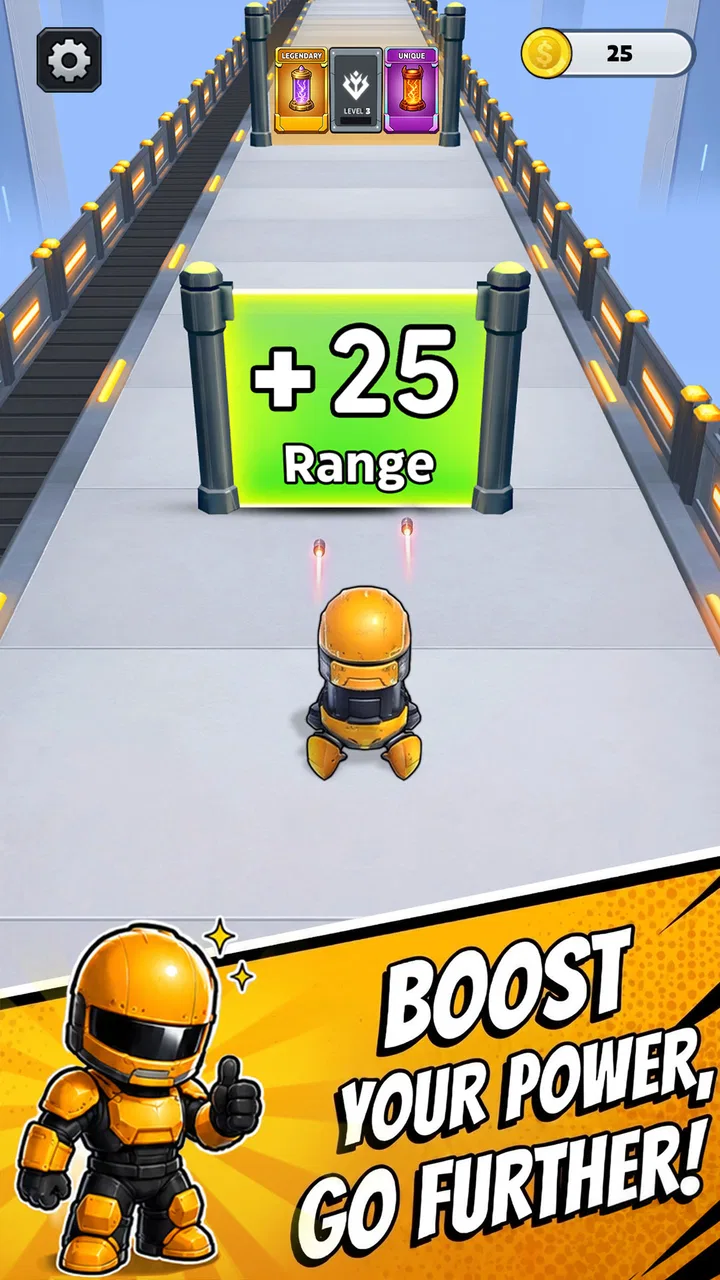
I went into Robot Era Evolution expecting a quick action game built around constant movement, and that is the right way to approach it. You guide a growing robot force through obstacle-filled runs, trying to turn a modest starting group into something much harder to stop. The idea is easy to understand within moments, but the appeal comes from deciding how aggressively to play while keeping an eye on the strength of your evolving army.
That simple premise makes it a natural fit for short sessions. I can imagine opening it while waiting for an appointment, playing a few runs during a commute, or returning to it when I want action without learning a large set of controls. It is free to download, although optional purchases range from twenty-nine cents to nine dollars and ninety-nine cents per item. That makes the first step easy, but I would still treat the purchase options carefully until I knew how much progress depended on them.
How the robot runs feel in everyday play
The main strength is immediacy. There is no complicated setup to understand before the action begins: the game presents a robot-building goal and places that goal inside an obstacle-running format. I like that combination because it gives each attempt a clear purpose. I am not simply trying to survive; I am also trying to make the group more powerful and reach a point where the run feels increasingly unstoppable.
You May Also Like

 Blood Strike: 2.5 Anniversary
Blood Strike’s Loadouts Turn Every Drop Into a Tactical Gamble
A close look at Blood Strike’s custom loadouts: how fast access to signature weapons reshapes its battle royale rhythm, rewards preparation, and narrows the gap between fights.

 Pandora - Music & Podcasts
Pandora’s Music Is Easy to Start, but Harder to Recover
Pandora’s strength is its low-effort path from a seed to a station. Its weak spot is how much confidence it asks you to place in connection, setup, and quiet recovery.

 8 Ball Pool
 Is Built on Rivalries, Rematches, and Routine
A close look at the rivalries, rematches, shared routines, and unanswered safety questions that turn a quick pool match into a persistent mobile community.

 Samsung Music
’s Quiet Strength Is Playing What You Already Own
Its reach comes less from spectacle than from dependable access to a personal library. That simplicity is both the app’s strongest retention engine and its ceiling.

 AccuWeather: Weather Radar
AccuWeather Review: A Quick, Clear Forecast for Everyday Decisions
For everyday plans, the best forecast is the one you can understand quickly. AccuWeather makes rain timing, radar, and local conditions easy to act on, with a few trade-offs.

 Hill Climb Racing
Why Hill Climb Racing Still Turns Crashes Into One More Run
A tiny car, a bumpy hill and one more upgrade: Hill Climb Racing keeps resurfacing because its simple chaos makes every near-miss feel personal.
More From Our News Desk
View All News


For a casual player, the learning curve should feel approachable. The action category is clear from the moment the game starts, and the robot theme gives the progression a visual identity that separates it from ordinary runners. The most satisfying moments are likely to come when a run begins with a small force and gradually feels more substantial. That sense of accumulation is more important here than a complicated story or a large collection of menus.
My advice is to treat the early attempts as observation runs rather than immediately chasing perfect results. Watch how obstacles affect your movement, notice which choices preserve the size of your group, and avoid making every decision based only on the next few seconds. A larger robot army can make the later part of a run feel safer, but careless movement at the beginning can undermine that advantage before it matters.
One useful habit is to separate progress from panic. When the screen becomes busy, I would rather make a controlled choice that protects the army than react to every obstacle with a sudden change of direction. This is a small distinction, but it matters in games where the player is balancing movement with a growing group. The best route is not always the one that looks most rewarding immediately.
What speed means in this particular game
The perceived pace is likely to come less from complex combat and more from how quickly the run asks me to read obstacles and commit to a route. That keeps the game accessible, but it also means the experience may feel repetitive for players who want deep tactical battles or a slower strategy layer. I would recommend it to someone who enjoys fast decisions with a visible progression goal, not to someone searching for a full-scale robot management game.
Short sessions are where the design makes the most sense to me. A quick run has a beginning, a series of movement choices, and a clear attempt to improve the robot force. If I only have a few minutes, I can focus on one practical target, such as surviving longer or learning a troublesome section. If I have more time, I can keep experimenting, but I would not expect the same depth as a large action role-playing game.
The current version is 0.005, which is an important detail when setting expectations. A version number this early suggests that the experience may still be developing, so I would approach it as a compact game with room to mature rather than as a finished, content-heavy action title. That does not make it a poor choice, but it does make patience more valuable. Players who enjoy seeing a small game take shape may be more comfortable here than those who expect a highly polished, feature-rich release from the first session.
When the action becomes demanding
The heaviest moments are not necessarily the longest ones. A short sequence can feel demanding when several obstacles arrive close together and I have to choose between preserving the army and taking a risk for greater growth. Those moments are where the central idea earns its place. The robots are not just decoration; their size gives each decision a consequence that I can understand immediately.
I would play more conservatively when a run has already built up a useful force. Early in an attempt, taking a risk can teach me something and may be worth the possible loss. Later, the same risk can erase the progress that made the run interesting. This creates a practical rhythm: experiment while the cost is low, then protect the result once the army becomes valuable.
That approach also helps with device use. If I am playing while multitasking, I would avoid starting a run that requires full attention. A phone call, a conversation, or a brief interruption can be enough to spoil a movement sequence. The game is better suited to moments when I can look at the screen continuously, even if the overall session is short.
I would also avoid judging the game after one difficult attempt. Obstacle runners often feel harsher when the player has not yet learned the visual language of the course. A failed run can still be useful if I identify whether the problem was impatience, poor positioning, or an overly ambitious route. That kind of self-correction is more rewarding than simply repeating the same movement and hoping for a different outcome.
Stability, recovery, and the cost of a failed run
Reliability matters especially in a game built around runs. Losing because of a poor decision is understandable; losing because the game interrupts the session is much more frustrating. My practical recommendation is to keep the first sessions simple and pay attention to how the game behaves when I leave it briefly, switch away, or return after an interruption. That is a sensible check before investing serious time or making any purchase.
Recovery is also part of the experience. If a run ends, I would want to be able to understand what went wrong and begin again without feeling that the entire session was wasted. The robot-army concept supports this naturally because each attempt can function as a small lesson: preserve more units, approach a particular obstacle differently, or delay a risky choice. That makes restarting feel more purposeful than in a runner with no meaningful progression goal.
At the same time, I would not assume that every failed run will feel equally fair. The early version status means I would leave room for rough edges in pacing or balance. If a section repeatedly feels unclear rather than challenging, I would adjust my expectations instead of treating it as a test of skill alone. A developing action game can be enjoyable while still needing refinement in the way it communicates danger and rewards.
The public response is mixed, with an average of 3.2 from around one hundred ratings and thirteen written reviews. I read that as a reason to approach the game with realistic expectations rather than as an automatic rejection. The sample is modest, and the early version matters, but the rating does suggest that the experience may not satisfy everyone equally. I would use the first few sessions to decide whether its particular run-and-evolve loop works for me.
How demanding it may feel on a phone
The game supports devices running Android 8.0 or later, so it is aimed at a broad range of Android phones rather than only the newest hardware. That makes it more approachable for people who do not upgrade frequently. Still, minimum compatibility does not guarantee identical comfort on every device. Screen size, touch response, background activity, and available storage can all affect how pleasant a fast obstacle sequence feels.
For a smoother experience, I would close demanding apps before playing, especially on an older phone. I would also avoid judging responsiveness while the device is busy with downloads or many background tasks. These are ordinary precautions, but they are particularly useful here because a small delay can turn a deliberate movement into an accidental collision.
Resource demands are worth considering without assuming a precise technical profile. A game centered on moving obstacles and a growing group of robots may feel busier as the army expands, so I would pay attention to whether the screen remains responsive during the most crowded sections. If the phone becomes warm or the controls feel less precise during longer sessions, shorter play periods would be the sensible compromise.
Battery-conscious players should approach it as a game for focused bursts rather than an all-day activity. I would not leave it running in the background, and I would avoid playing while the phone is already handling several heavy tasks. The best setup is simple: enough battery, a clear screen, and a stable grip. That matters more than trying to force a long session from a small action game.
The Teen content rating is another practical consideration. I would not choose it automatically for a younger child simply because the robot theme looks playful. Parents should check the game directly and consider the age guidance, especially because optional in-app purchases are available. For teenagers and adults who enjoy light action and quick progression, the rating is less of a concern, but it still helps set the intended audience.
Where it stands beside familiar alternatives
Compared with a traditional endless runner, this game has a stronger sense of purpose because the robot group gives the run a visible growth target. In a standard runner, I may focus almost entirely on distance and personal reflexes. Here, I am also thinking about the size and strength of the force I am building. That extra layer makes mistakes feel more connected to the central theme.
Compared with a deeper strategy game, however, the experience is likely to be much lighter. I would not choose it if I wanted detailed unit placement, long-term resource planning, or a large campaign. The attraction is the immediate connection between movement and evolution, not a complex command system. Someone who finds management screens tiring may prefer this approach, while a strategy fan may soon want more control than a quick runner can provide.
It also differs from a combat-focused robot game. The satisfaction here comes from navigating obstacles and growing the army, so players looking for elaborate attacks, equipment builds, or tactical battles should look elsewhere. I appreciate that focus because it keeps the game easy to pick up, but it naturally limits the variety of play compared with a larger action title.
One trade-off is replay value. The evolving army can give me a reason to try again after a failed run, particularly when I know exactly which decision cost me progress. But if the obstacle patterns or progression do not offer enough variation over time, the loop may lose its pull. I would recommend trying it in short bursts first rather than assuming the initial novelty will support long daily sessions.
Who should try it, and who should skip it
I would recommend it to players who like compact action games, robot themes, and visible growth during a run. It is also a good candidate for someone who wants a free starting point and does not need a lengthy story before the gameplay becomes interesting. The simple objective makes it suitable for a quick break, while the army-building angle gives each attempt more meaning than a purely score-based dash.
I would skip it if I need a polished, extensive game with many systems from the start. I would also look elsewhere if I dislike repeating runs, have little patience for learning obstacle timing, or want a game that can be played comfortably while my attention is divided. The action may be approachable, but it still asks me to watch the screen and make timely decisions.
Players who are sensitive to in-app spending should decide on a personal rule before starting. Since purchases run from twenty-nine cents to nine dollars and ninety-nine cents per item, it is easy to see the game as inexpensive at first while still facing optional spending later. I would play the free portion long enough to understand the progression before buying anything. That gives me a clearer idea of whether a purchase improves enjoyment or merely speeds up a loop I have not yet decided to keep.
My practical verdict after weighing the trade-offs
Bolt Bridge Games has built a focused action game around a clear hook: move through obstacles while turning a small robot force into a stronger one. I like the way that goal gives ordinary movement decisions a visible consequence. The game is easiest to recommend as a casual, early-stage experience for people who enjoy quick attempts and do not mind a little roughness while the project develops.
My strongest tip is to protect the army once it becomes valuable. Use the first part of a run to learn, then stop chasing every tempting opportunity when the risk becomes greater than the likely reward. I would also test the game on the device I plan to use, especially if it is older, and keep early sessions short enough to judge responsiveness without confusing device strain with game quality.
The final decision comes down to expectations. With over fifty thousand installs, it has attracted a meaningful audience, but its 3.2 average and early version suggest a game that may appeal strongly to some players while leaving others wanting more polish or depth. I would give it a try if I wanted a free robot-themed runner with an evolution angle. I would pass if I was searching for a complete strategy experience, elaborate combat, or guaranteed long-term variety.
In my view, Robot Era Evolution is most enjoyable when treated as a focused pick-up-and-play experiment rather than a replacement for a major action game. Its best moments come from watching a vulnerable group become powerful through careful movement. Its limitations are equally clear: the compact loop, developing version, and possible performance differences between devices mean it needs the right audience. For that audience, it is worth testing; for everyone else, the free entry point makes a brief hands-on trial the fairest way to decide.
FAQs for Robot Era Evolution
01What is Robot Era Evolution?
Robot Era Evolution is a mobile game centered on futuristic robots, battles, upgrades, and progression. Players typically build and improve a collection of mechanical fighters, take part in combat missions, and unlock stronger equipment or abilities as they advance. The game is aimed at users who enjoy science-fiction themes, strategic decisions, and action-focused gameplay with a long-term upgrade system.
02How does the gameplay work in Robot Era Evolution?
Gameplay generally combines robot management with combat and progression. You choose or deploy mechanical units, improve their statistics, equip available weapons or parts, and face increasingly challenging opponents. Success depends on selecting suitable upgrades and using each robot effectively rather than relying only on automatic progress. New stages, rewards, and development options help keep the experience moving forward.
03Can Robot Era Evolution be played offline?
Offline availability can depend on the specific mode and version installed. Some basic or single-player sections may work without a continuous connection, but online features, advertisements, cloud saves, events, leaderboards, purchases, and account-related functions usually require internet access. Before downloading, players who often travel or have limited data should check the store description and test which features remain available offline.
04Is Robot Era Evolution free to download and play?
Robot Era Evolution may be available as a free download, but free access does not necessarily mean that every feature is completely cost-free. Games in this category commonly include optional in-app purchases for currency, upgrades, resources, or convenience items, and advertisements may also appear during play. Review the app-store listing, payment settings, and parental controls before allowing purchases on the device.
05What devices are compatible with Robot Era Evolution?
Compatibility depends on the current Android or iOS release, the operating-system version, available storage, and the device’s hardware performance. Because robot battles can include detailed graphics and frequent effects, older phones or tablets may experience slower loading, reduced visual quality, or occasional performance issues. Check the official store page for the latest requirements and install the game only from a trusted source.
Pros
- Strategic battles reward careful team composition and timing.
- Robot upgrades provide a satisfying sense of long-term progression.
- The futuristic setting gives the game a distinctive visual identity.
- Short missions make it easy to play during brief sessions.
- Different robot abilities encourage experimentation with team builds.
Cons
- Some upgrades may require considerable grinding to unlock.
- The interface can feel crowded for new players at first.
- Progress may slow noticeably without regular play.
- Certain battles can become repetitive after extended sessions.
- Device performance may vary on older phones and tablets.

Robot Era Evolution
Gallery